Vol. 1 No. 1 (2025): Public Administration and Governance Studies Journal
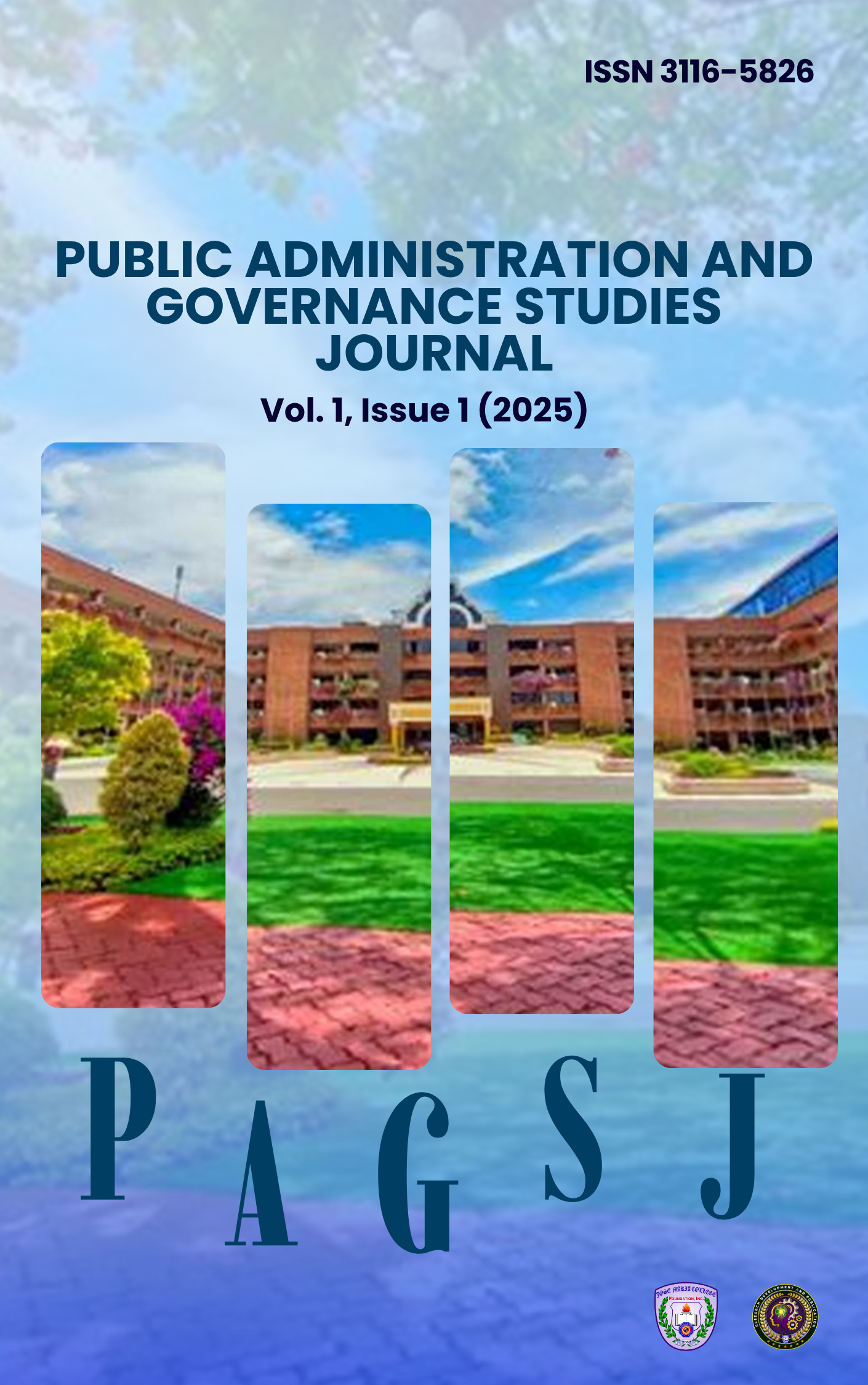
The launch of a new journal invites reflection not only on the state of a discipline but also on the normative commitments that animate scholarly inquiry. For the Public Administration and Governance Studies Journal, those commitments are captured in the twin concepts that frame this maiden issue: fairness and justice. These terms are not decorative; they denote the evaluative criteria against which governance systems must be judged. A public administration that fails to distribute resources and burdens equitably, that excludes marginalized voices from decision‑making, or that enforces rules without transparency or accountability, forfeits its legitimacy. Yet fairness and justice are not self‑executing. They are achieved—or undermined—through the mundane, everyday practices of institutions: how banks process loan applications, how conservation programs engage youth, how correctional facilities treat their officers, how political parties recruit women candidates, and how cities enforce public health ordinances.
The five studies collected here examine precisely such practices across five governance domains. Read separately, each contributes empirical evidence to a specific policy field. Read together, they reveal a more fundamental pattern: governance gaps that manifest as distributive inequalities, procedural exclusions, and unrecognized capabilities. In each case, fairness is not absent but misallocated—or conditional on attributes that should be irrelevant to just treatment.
Financial governance and distributive justice. The first study investigates ethical banking practices in the post‑pandemic Philippines. Universal banks are tasked with an inherently fragile mandate: to pursue profit while safeguarding public accountability. The pandemic intensified this tension, exposing how digital transformation and regulatory adaptation can either narrow or widen inequalities in access to credit, fraud protection, and responsive dispute resolution. The study surfaces five dimensions of ethical banking that directly map onto distributive justice (who receives favorable lending terms and security against fraud) and procedural fairness (whether customers perceive processes as transparent, consistent, and non‑arbitrary). The finding that customers value security and relationship support alongside innovation underscores a basic justice principle: financial inclusion cannot be reduced to access alone; it requires ongoing institutional accountability.
Environmental governance and intergenerational justice. The second study turns to marine protected areas (MPAs) and the role of youth in their implementation. Environmental conservation inevitably involves trade‑offs—between ecological integrity and fishing livelihoods, between immediate enforcement and long‑term community stewardship. The study’s key insight is that youth perceive MPAs not merely as biodiversity tools but as sites of community‑driven empowerment and, conversely, as arenas of exclusion. When young people are relegated to passive compliance rather than active participation, the governance process violates intergenerational justice: those who will inherit the consequences of today’s environmental decisions have the least say in shaping them. The study’s call for educational empowerment and community integration is therefore a call to treat youth as co‑designers of conservation, not as objects of policy.
Criminal justice and organizational fairness. The third study examines correctional officers’ well‑being through the lenses of distributive justice and locus of control. Correctional institutions are uniquely hierarchical environments, and the well‑being of their personnel is rarely prioritized in justice research. Yet the fairness experienced by officers—how rewards, recognitions, and workloads are allocated—directly shapes their psychological agency and, by extension, the quality of the institutional environment they maintain. The study finds that perceived distributive justice and internal locus of control significantly predict occupational well‑being. This finding extends justice theory to state agents themselves: a criminal justice system that disregards the fair treatment of its own employees risks a legitimacy deficit that cascades throughout the entire apparatus.
Gender justice and political representation. The fourth study investigates the social, economic, and political challenges facing women in local political leadership. The demographic profile of female officials—predominantly married, middle‑aged, and concentrated in lower‑tier positions—is not incidental. It reflects operative social norms that confer legitimacy on the basis of perceived maturity and domestic stability, while simultaneously imposing care burdens that systematically exclude younger women and those without spousal support. The study documents three intersecting domains of constraint: social (dual identity management, gender stereotypes), economic (financial barriers, limited formal credentials), and political (electoral skepticism, motivational conversion of doubt). The coping strategies women develop—competence‑based legitimacy, maternal resilience, adversity‑to‑motivation conversion—are individually admirable but collectively insufficient. A justice‑oriented governance framework would not celebrate such resilience as an end in itself; it would dismantle the structural conditions that make resilience a survival requirement.
Public health governance and informational justice. The fifth study analyses college students’ awareness of an anti‑smoking ordinance and its correlation with smoking beliefs. The findings reveal a crucial asymmetry: high ordinance awareness strengthens negative health beliefs and perceived barriers to smoking but does not operate through social normative pathways. This suggests that the current governance model relies heavily on informational justice (whether rules are clearly communicated and consistently enforced) while neglecting normative justice (whether the social environment supports compliance through collective expectations). The implication is not that enforcement is unimportant, but that fairness in health governance requires a dual strategy: visible sanctions complemented by community‑based norm change. An ordinance that punishes smoking without reshaping the social acceptability of the behavior places an unequal burden on individuals who lack peer support for quitting.
What unites these five inquiries is a shared commitment to moving beyond formal proceduralism toward substantive governance justice. Formal justice asks whether rules exist and are applied uniformly. Substantive justice asks whether the outcomes of those rules—and the processes that produce them—are fair to all affected parties, especially those with less power, voice, or resources. The banking study asks whether consumer protection rules translate into equitable access to credit. The MPA study asks whether conservation rules include youth as decision‑makers. The correctional study asks whether personnel policies treat officers as valued agents rather than disposable functionaries. The women’s leadership study asks whether electoral rules enable substantive political agency or merely formal candidacy. The anti‑smoking study asks whether public health rules are reinforced by social norms or left to individual willpower alone.
Each study also demonstrates methodological pluralism—exploratory factor analysis, phenomenology, quantitative‑correlational design, convergent mixed methods, and descriptive‑correlational analysis—as a deliberate strategy for capturing the multidimensional nature of fairness. No single method can fully capture how justice is experienced, contested, or institutionalised. The journal will continue to encourage this methodological openness.
This maiden issue would not exist without the trust of our authors, the rigour of our peer reviewers, and the institutional support of the Jose Maria College Foundation and our partner institutions. We extend our particular gratitude to the communities and research participants who shared their experiences, often on sensitive topics, in the belief that scholarship can inform better governance.
As we open submissions for future volumes, we invite work that continues to probe the normative foundations of public administration: not only what works, but for whom, under what conditions, and at what cost. Fairness and justice are not static endpoints; they are ongoing accomplishments of reflexive governance. We hope this journal becomes a forum for that reflexivity.
The Editor
Public Administration and Governance Studies Journal
Volume 1, Issue 1 | June 2025